
The Public Capacity Gap
Why nonprofit organizations must build the systems that ensure their work is understood, supported, and sustained
By Amani Olu | March 2026
Executive Summary
Many organizations struggle to turn strong programs into sustained support and credibility.
Nonprofit capacity-building asks: Can the organization operate effectively? Efforts focus on governance, staffing, finances, and program delivery.
But another, equally important question arises: Can the organization be understood, supported, and sustained in public?
These two questions point to different forms of organizational capacity. Operational Capacity determines whether programs can be delivered effectively, while Public Capacity determines whether the relationships and resources needed for program sustainability can be built and maintained.
Despite significant investment in strengthening operational capacity, the sector has devoted far less attention to the systems that build public understanding, engage stakeholders, and convert organizational work into durable relationships.
Without such systems, organizations often default to pursuing the most visible communications activity available: media coverage.
While press placements create moments of visibility, they rarely address deeper structural challenges such as donor engagement, partnership development, or institutional positioning.
This essay argues that a critical public capacity gap undermines many nonprofit organizations. It presents the Public Capacity Framework to distinguish between operational and public capacity as essential, interdependent dimensions of organizational sustainability.
Drawing on twenty years of work with cultural institutions, mission-driven organizations, and creative enterprises, the essay explores how communications infrastructure functions as a critical system through which organizations build public capacity.
Strengthening these systems can help organizations translate strong programs into sustained public understanding, support, and institutional resilience.
The Evidence
The public capacity gap is not abstract. Research across the nonprofit sector reveals consistent patterns that limit organizations’ ability to build and sustain public support.
Communications Infrastructure is Rare. More than 60% of nonprofit communicators work without a documented marketing or communications strategy. Among organizations with budgets under $10 million, 38% of communicators stand alone, solely responsible for all marketing and communications. Of these solo practitioners, 38% are the first to hold the role, inheriting no templates, systems, or institutional knowledge.
Donor Retention is Declining. Overall donor retention in the U.S. nonprofit sector fell to 42.9% in 2024—the fourth consecutive year of decline. Fewer than one in five new donors acquired in 2023 gave again in 2024. Research consistently shows that 46% of donors leave organizations due to inadequate communication: they feel unappreciated or lack meaningful information about how their gift is used.
Board Ambassadorship Remains Weak. While nonprofit boards generally perform well in internal governance, only 52% of organizations report that board members actively advocate for their missions externally. Both chief executives and board chairs consistently identify board ambassadorship as among the areas most in need of improvement.
Investment Falls Short of Need. Industry benchmarks recommend that nonprofits allocate 5–15% of their operating budgets to marketing and communications. The actual median nonprofit investment is approximately 0.66%, roughly one-tenth of the recommended level. This gap persists not because organizations undervalue communications, but because it is categorized as overhead rather than infrastructure.
These recurring patterns reflect chronic underinvestment in public-facing communication systems.
Operational Capacity vs. Public Capacity
Most nonprofit capacity-building frameworks focus on operational effectiveness. They assess whether an organization has established governance structures, hired appropriate staff, implemented financial management systems, and developed the processes necessary to deliver its programs.
These are essential components of organizational health.
But organizations also operate within a broader ecosystem of stakeholders whose support sustains their work: funders, donors, partners, board members, policymakers, and the communities they serve. To endure over time, organizations must not only deliver programs effectively; they must also be understood, trusted, and supported by these stakeholders.
This reflects a different dimension of organizational capacity.
Operational capacity refers to the internal systems and processes that enable program delivery. Public capacity, by contrast, refers to an organization’s ability to build and maintain the relationships and resources that sustain those programs.
While the nonprofit sector has invested heavily in strengthening operational capacity, far less attention has been paid to the systems organizations use to build public understanding, maintain stakeholder relationships, and convert program quality into lasting public trust.
The Public Capacity Framework
The Public Capacity Framework distinguishes between two dimensions of nonprofit sustainability: Operational Capacity and Public Capacity.
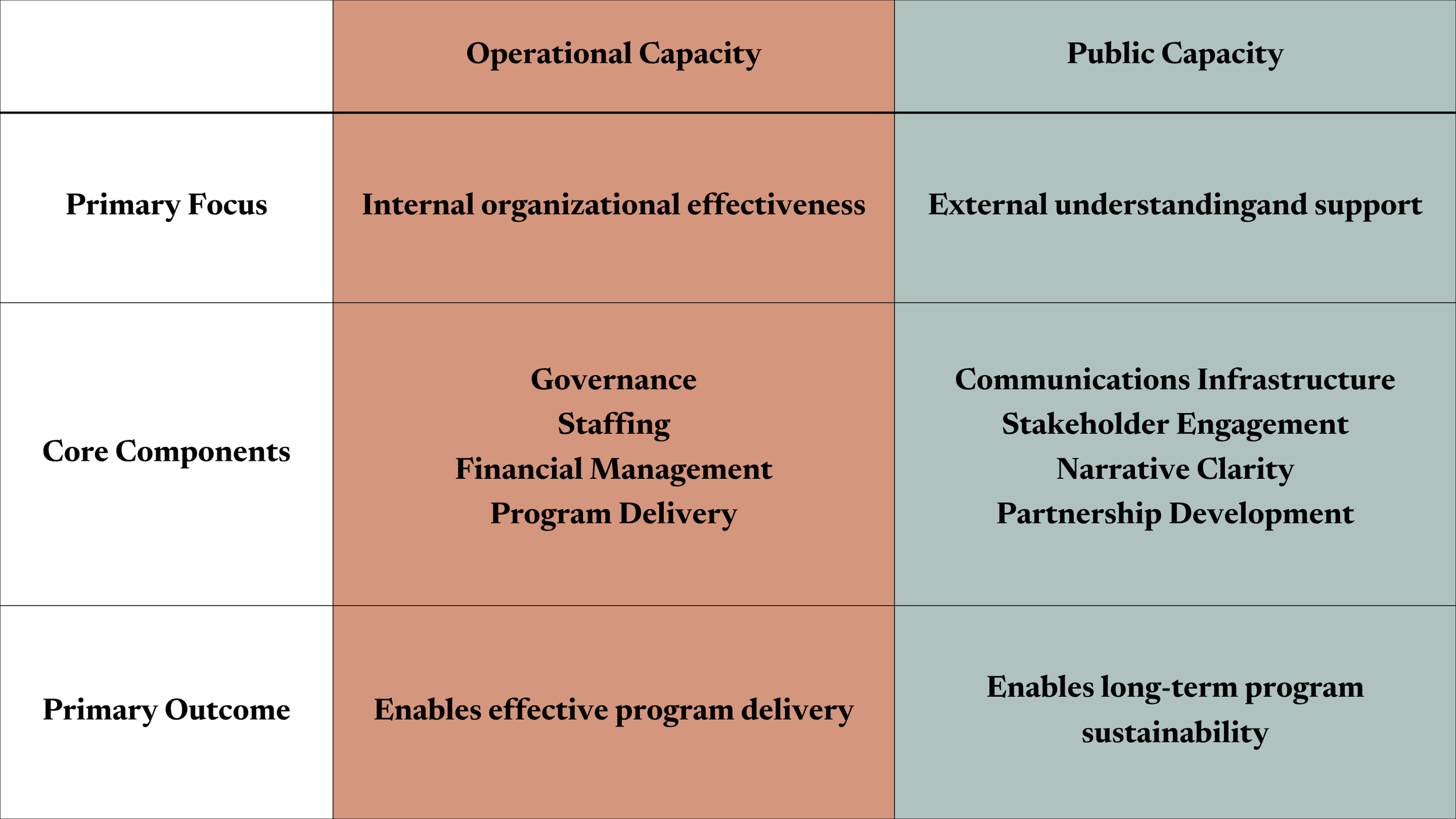
The Public Capacity Framework synthesizes existing ideas about communications, development, partnerships, and narrative into a single lens for understanding how organizations build and sustain public understanding and support. It does not suggest that communications infrastructure can replace structural change, power-building, or equity work – rather, it describes how organizations translate those efforts into durable relationships, resources, and institutional resilience.
Public capacity is not synonymous with publicity, branding, or media coverage. It is reflected in outcomes: donor retention, partnership depth, and an organization's ability to attract and sustain support within its ecosystem. This essay draws on sector research and practice-based experience. Its central claim is straightforward: when organizations lack simple systems for communicating clearly and engaging stakeholders consistently, strong programs often fail to generate the public understanding needed to endure.
The goal is not to create additional work – particularly for small organizations – but to reframe scattered communications activities into a small set of systems that align stakeholders, reduce duplication, and strengthen long-term sustainability.
Architecture of the Public Capacity Framework
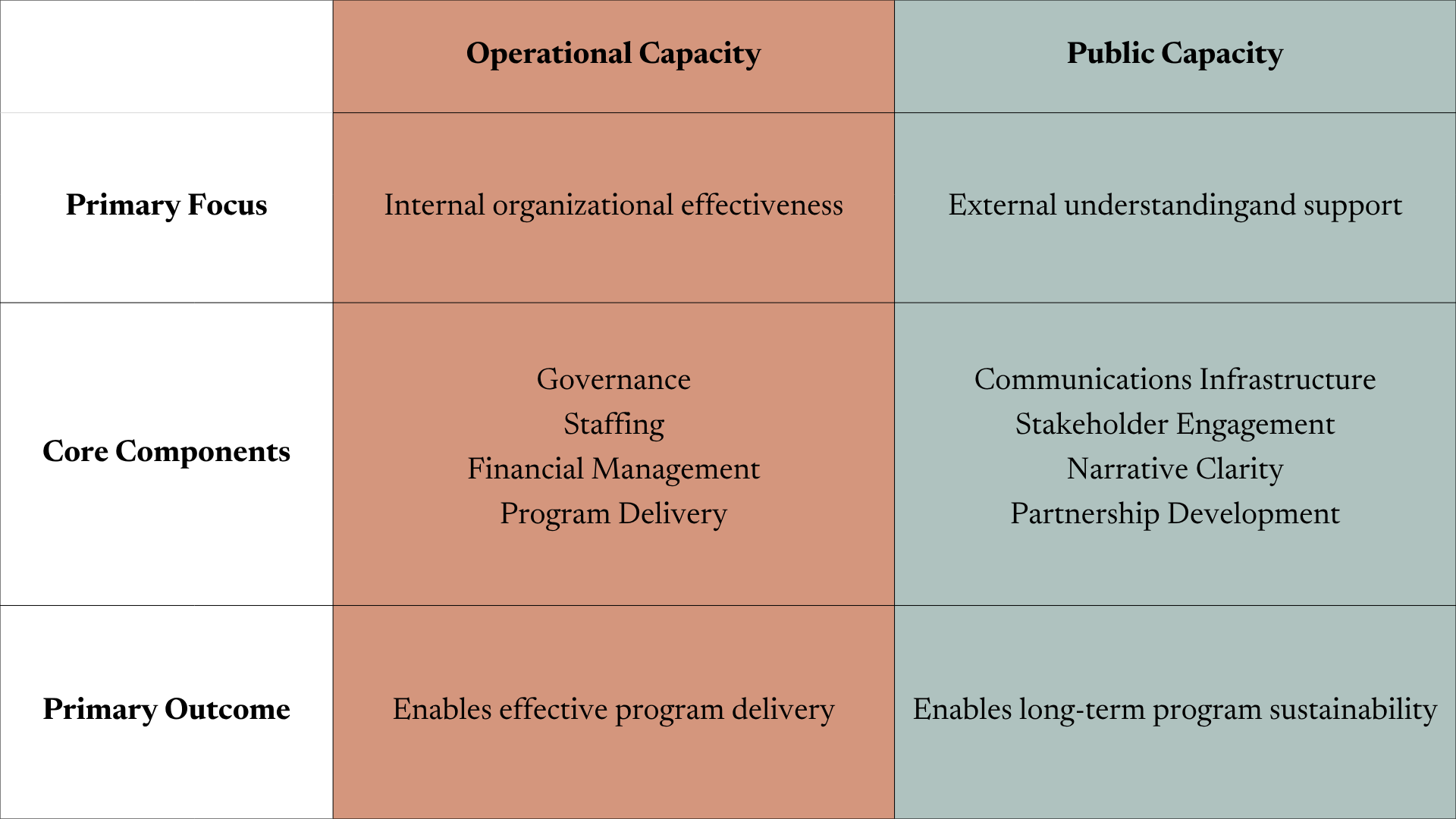
The Public Capacity Framework helps explain a persistent paradox: organizations doing strong work that still cannot secure the support needed to endure. In practice, this gap often arises in everyday communication activities.
Public Capacity as Organizational Infrastructure
Public capacity is not owned by a single department. It emerges from coordinated work across leadership, development, communications, programs, and partnerships. As outlined in the Public Capacity Framework, communications infrastructure is one of the primary systems through which organizations build public capacity.
In practice, these functions often operate separately. Program teams focus on delivery, communications teams focus on visibility, and development teams focus on fundraising. Without shared narrative frameworks and coordinated stakeholder engagement, these activities rarely reinforce one another. Communications infrastructure provides the systems that align these functions, ensuring that fundraising messages, partnership outreach, program narratives, and public communications reinforce one another rather than operating independently.
Consider an organization developing a new workforce initiative. Before the program launches, leadership identifies the stakeholders whose support will be essential: funders, employers, and community organizations. Communications staff develop a clear narrative describing the problem and the organization’s approach. Development staff use that narrative in conversations with funders, while program leaders and board members reinforce it in community partnerships. Because the organization operates on shared messaging and coordinated stakeholder engagement, program design, fundraising, partnerships, and communications reinforce one another.
This alignment is what builds public capacity.
Traditional Model vs Public Capacity Model
In many nonprofit organizations, communications and fundraising are integrated into the process only after programs have already been designed. The Public Capacity Framework suggests a different approach.
Public Capacity Connects Organizational Work and the Public Ecosystem
In this model, communications infrastructure does not simply promote programs after they are developed. It helps ensure that programs are designed, positioned, and sustained within the broader ecosystem of relationships that supports organizational work.
The Public Capacity Gap
The Public Capacity Framework helps explain a structural challenge affecting many nonprofit organizations: a public capacity gap.
Many nonprofits see communications as tasks rather than a core function.
Typical communications activity includes:
writing press releases
managing social media accounts
sending non-personalized and non-segmented newsletters
pitching stories to journalists
producing annual reports that are rarely used beyond compliance
designing marketing materials for individual programs
posting event announcements and recaps
Each activity has value. But without a communications framework, they rarely align or support long-term goals.
Communications then become reactive and fragmented. Organizations communicate often but not coherently.
One sign of this problem is the confusion between media and public relations, which muddies priorities and weakens connections.
Media relations refers specifically to engaging with journalists and news outlets to secure coverage.
Public relations, unlike other business functions, manages an organization’s relationships with its stakeholders.
Press coverage builds visibility and legitimacy. But without broader systems, it can’t replace the deeper work of building stakeholder relationships and public understanding.
Communications Capacity Defined
Communications capacity refers to an organization’s ability to consistently articulate its mission, engage stakeholders, and demonstrate the public value of its work.
In particular, communications capacity supports public capacity development. It enables organizations to communicate clearly, cultivate relationships, and maintain alignment among stakeholders.
To achieve this, organizations rely on strong communications capacity, which typically includes several interdependent systems.
Messaging frameworks
Stakeholder communication systems
Internal alignment
Content infrastructure
Measurement and evaluation
However, when these systems are absent, communications become improvisational. As a result, staff recreate materials repeatedly, messaging varies across departments, and stakeholders receive inconsistent information.
These gaps persist over time, ultimately limiting an organization’s ability to build public capacity. As a result, sustainability is threatened, and broader mission achievement is jeopardized.
What Communications Infrastructure Looks Like
Organizations with a strong communications infrastructure deploy simple systems to ensure consistent messaging and drive stakeholder engagement.
Examples include:
Board Talking Points
Board talking points are concise one-page references board members use to describe the organization in meetings, introductions, and donor conversations. These points include the vision, mission, a summary of impact, key programs, and current priorities. Regularly updating these ensures board members communicate consistently and with confidence.
Stakeholder Communication Sequences
Template-driven communication plans show how to engage stakeholders over time. Instead of sporadic outreach, organizations schedule structured sequences: onboarding new donors, updating partners, or sending regular communications to the community. These sequences ensure timely, consistent information reaches all key stakeholders.
Content Repurposing Systems
Organizations use processes to adapt one piece of content for multiple audiences and channels. For example, a program update or impact story appears in newsletters, grant reports, social media, partner briefings, and board updates. Repurposing content saves time and keeps messaging consistent.
Narrative Alignment Materials
Staff and partners use a shared set of reference materials to communicate consistently about the organization. These materials include fact sheets, impact summaries, frequently asked questions, and responses to tough questions. Documenting narratives reduces confusion and keeps key messages aligned across teams.
Thought Leadership Content
Organizations create articles, essays, research briefs, and commentary to share their perspective on relevant issues. Thought leadership establishes credibility and gives funders, partners, and media language that reflects the organization’s broader vision.
Quarterly Narrative Reviews
Leadership and staff meet regularly to review how they describe the organization and ensure that messaging aligns with current priorities. These meetings update talking points, refine narrative frameworks, and find new stories that highlight impact. Narrative reviews keep internal strategy and external communication aligned.
Importantly, implementing these systems does not require significant budgets; rather, it requires intentional design and consistent use.
Building Public Capacity with Limited Resources
Even very small organizations can begin strengthening public capacity through simple systems.
Each of these simple systems streamlines communication:
A one-page narrative that describes the vision, mission, and core values ensures everyone shares a unified message about the organization.
A shared email template used for donor updates and partnership outreach
A donor outreach calendar helps staff coordinate consistent, timely communication about gratitude, updates, and impact.
A set of board talking points updated quarterly
A quarterly one-hour meeting gives staff a chance to align messaging and discuss stakeholder priorities, keeping communication relevant and focused.
These small changes allow staff, board members, and partners to communicate consistently about the organization.
Over time, these systems help organizations cultivate relationships, attract support, and sustain their programs.
Public capacity starts with simple, intentional steps.
The Costs of Limited Public Capacity
When organizations lack a communications infrastructure, the consequences are immediate and severe, reaching far beyond marketing setbacks.
Lost Fundraising Capacity
Building on this, board members are often expected to introduce new supporters and cultivate donor relationships. When they cannot clearly articulate the organization’s work, those opportunities are lost. Without clear messaging and supporting materials, even well-intentioned advocates struggle to communicate the organization’s impact effectively.
Missed Institutional Funding
Similarly, foundation program officers frequently evaluate organizations based on narrative clarity and strategic positioning. Organizations with inconsistent messaging or unclear descriptions of their work may struggle to compete for major grants, even when their programs are strong.
Partnership Failures
In addition, strategic partnerships depend on clear value articulation and consistent communication. When organizations cannot clearly explain their role, priorities, or impact, potential collaborations may fail to develop or remain limited in scope.
Staff Inefficiency
These challenges also impact internal efficiency. Without clear messaging frameworks or reusable communication materials, staff are forced to redundantly explain the organization’s work—wasting precious time, delaying decisions, and dramatically hindering organizational efficiency.
Institutional Credibility Challenges
Ultimately, organizations with inconsistent messaging often struggle to establish a clear identity within their field. Over time, this lack of narrative clarity can limit their ability to attract supporters, collaborators, and institutional recognition.
Communications Capacity Assessment
Communications capacity assessments help you assess your strengths across critical areas.
Messaging Clarity
Evaluate whether staff, leadership, and board members can consistently describe the organization’s work.
To determine if an organization communicates a clear and coherent narrative, assessments may review vision and mission statements, program descriptions, and public materials.
Stakeholder Communications
Assess whether there are structured communication systems for donors, partners, and community audiences.
This area explores whether outreach efforts are coordinated rather than sporadic, and if the organization maintains predictable communication rhythms with key stakeholders.
Internal Alignment
When you ask different staff members about your organization, do you get the same story every time?
Staff interviews or workshops often evaluate internal alignment by exploring how different teams describe the organization’s priorities and impact.
Content Infrastructure
Assess whether the organization maintains reusable materials and messaging frameworks.
Core communications materials, such as fact sheets, impact summaries, board talking points, and narrative frameworks, are typically reviewed during assessments to ensure the organization maintains them.
Measurement and Evaluation
Examine if communications activities are evaluated based on outcomes rather than visibility metrics.
While many organizations measure communications success primarily through outputs such as media placements or social media engagement, capacity assessments examine whether communications efforts link to outcomes like donor retention, partnership development, or program participation.
Strengthening Public Capacity
For many organizations, strengthening public capacity does not begin with launching large marketing initiatives. It begins with clarifying how the organization communicates its work, aligning internal narratives, and engaging the stakeholders who sustain its mission.
Organizations can begin strengthening public capacity through several foundational steps:
Clarifying organizational narrative
Mapping key stakeholders
Building communications infrastructure
Aligning internal and external communication
Even small investments in these systems can significantly strengthen an organization’s ability to cultivate relationships, attract resources, and sustain its work within the broader public ecosystem.
Strong programs alone do not guarantee sustainability. Organizations must also demonstrate their value, foster partnerships, and engage consistently with the stakeholders who enable their work to continue.
Public capacity grows when communications systems, stakeholder relationships, and institutional narratives reinforce one another over time.
Operational capacity enables programs to run.
Public capacity enables them to endure.
About the Author
Amani Olu is the founder of Olu & Company, a consultancy that partners with cultural institutions, mission-driven organizations, and creative enterprises to strengthen organizational sustainability through capacity building, strategic marketing, and business development.